
Understanding Client-Server Architecture: The Foundation of Modern Digital Experiences
A practical guide to client-server architecture, its components, architectural tiers, request flow, advantages, limitations, and real-world applications.
Every time you open a webpage, refresh a social feed, place an online order, or join a multiplayer game, two sides of a distributed system are working together: a client requests a capability, and a server provides data or performs the required processing. This relationship is the foundation of most modern digital products.
This blog explains the client-server model, its core components, common architectural tiers, a practical request flow, real-world uses, and the trade-offs engineers must consider when designing reliable systems.
| Concept | What it means | Typical examples |
|---|---|---|
| Client | Initiates requests and presents results to the user. | Browser, mobile app, desktop application |
| Server | Processes requests, applies business rules, and returns responses. | Web server, API server, game server |
| Data store | Persists information needed by the application. | Relational database, document store, object storage |
What Is Client–Server Architecture?
Client–server architecture is a network model in which clients and servers communicate over a network to complete a task or exchange data. The client is usually the user-facing application: it captures an action, constructs a request, and renders the result. The server receives that request, performs an operation or accesses data, and sends back a response.
For example, when a browser requests a webpage, it sends an HTTP request to a web server. The server may retrieve data, execute application logic, and return HTML, CSS, JavaScript, images, or JSON. HTTP defines the request–response semantics used by the web, while HTTPS adds encryption in transit.
Why the Model Matters
A clear mental model of client–server communication helps engineers trace how information moves from an interface to backend systems and back again. It also makes it easier to reason about API design, authentication, authorization, latency, caching, failure handling, and scalability.
The separation between presentation and backend responsibilities is valuable because each side can evolve independently. A mobile application and a web application, for example, can consume the same backend API while presenting different user experiences.
Core Components
Client
The client handles user interaction, validates input, formats it, constructs requests, and renders responses. It may communicate with a server using HTTP or HTTPS for standard request–response interactions, WebSockets for persistent two-way communication, or other protocols suited to the product's needs.
Server
The server listens for incoming requests and coordinates the work needed to answer them. It may authenticate the caller, validate input, apply business rules, call databases or external services, and return a structured response such as JSON, HTML, or binary data.
Supporting infrastructure
Production systems commonly add load balancers, caches, content delivery networks, message queues, monitoring, and multiple data stores. These components do not replace the client–server relationship; they make it more resilient, observable, and capable of serving many users.
Common Architectural Tiers
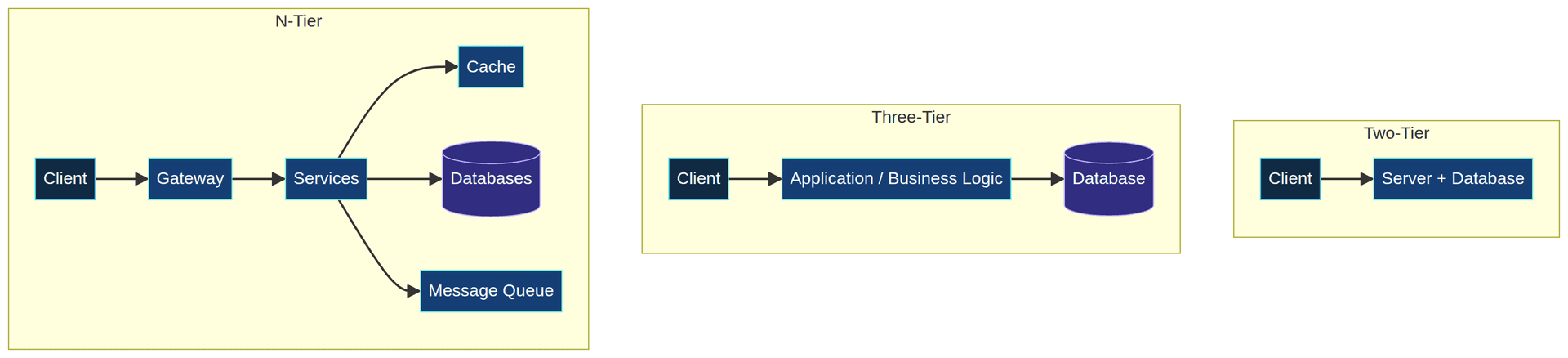
Two-tier architecture
In a two-tier system, the client communicates directly with a server that may also host or directly access the database. This arrangement is easy to understand and can work well for small applications, internal tools, or early prototypes. Its tight coupling becomes a limitation as security, deployment, and scaling requirements grow.
Three-tier architecture
A three-tier system separates the presentation tier, application or business-logic tier, and data tier. The client communicates with the application server rather than accessing the database directly. This separation improves maintainability and creates a clearer security boundary around sensitive data.
N-tier or multi-tier architecture
N-tier architecture extends the same separation with specialized components such as an API gateway, authentication service, cache, message queue, search service, analytics pipeline, or multiple databases. It is common in larger enterprise and cloud systems, but each additional tier also introduces operational and communication complexity.
The Request-Process-Response Flow
Most client-server interactions can be understood as a short sequence:
-
The client creates a request, such as
GET /api/books. -
A gateway, load balancer, or web server routes the request to the appropriate application service.
-
The application authenticates the request when necessary, validates inputs, applies business rules, and reads from or writes to a data store.
-
The server returns a response, often JSON for an API or HTML for a rendered page.
-
The client interprets the response and updates the user interface.

Practical example: an online bookstore
Suppose a user opens a bookstore catalog. The client sends GET /api/books with optional filters such as category or price range. The server authenticates the request if needed, validates the parameters, queries the database, and applies sorting or pagination. It then returns a JSON response containing titles, authors, prices, and cover-image URLs. Finally, the client renders the results as a list or grid.
This pattern is simple, but it captures the central rhythm of distributed applications: request, process, respond, render.
Real-World Applications
Web browsers and web servers use the model to deliver pages and assets. Mobile applications rely on backend APIs for feeds, catalogs, account information, payments, and location updates. Multiplayer games use servers to coordinate player state, matchmaking, and scores. Enterprise systems such as CRM, ERP, and collaboration platforms use the same basic pattern while adding stronger identity, auditing, integration, and availability requirements.
Advantages
Centralized management. Business rules and sensitive data can be managed primarily on the server, allowing teams to update backend behavior without shipping a new client every time.
Separation of concerns. Presentation, business logic, and data access can be developed, tested, and deployed as distinct responsibilities.
Scalability. Stateless application servers can often be replicated behind a load balancer, while caches and CDNs reduce repeated work and shorten delivery paths.
Security control. Authentication, authorization, validation, encryption, and auditing can be enforced at controlled server-side boundaries.
Efficient clients. Thin clients can offload computation and storage to more capable backend infrastructure, which is especially useful on constrained devices.
Limitations and Trade-offs
Network dependency. Latency, packet loss, limited bandwidth, and outages can directly affect the user experience.
Failure concentration. If a critical server or dependency becomes unavailable, many clients may be affected. Redundancy, health checks, graceful degradation, and disaster-recovery planning reduce this risk.
Operational complexity. High concurrency requires capacity planning, observability, caching, rate limiting, and often horizontal scaling. These capabilities improve resilience but increase cost and maintenance effort.
Security exposure. A network-facing service must validate untrusted input, protect credentials, enforce least privilege, and keep dependencies patched.
Design Questions to Ask
When applying the model to a real system, ask where state should live, which operations must be synchronous, what happens when a dependency times out, how clients authenticate, and how the system will be monitored. Also decide whether a simple monolith is sufficient before introducing microservices or additional tiers. Architectural complexity should solve a demonstrated problem rather than become a goal by itself.
Why Client-Server Architecture Still Matters
The technologies change, but the underlying reasoning remains useful. Whether a system uses a monolithic application, serverless functions, microservices, or managed cloud services, a client still needs a dependable way to request capabilities and receive results. Understanding that boundary helps engineers design clearer APIs, safer data flows, more effective caches, and better failure-handling strategies.
Conclusion
Client-Server architecture is the quiet engine behind most interactive digital products. By separating user-facing interaction from backend processing and data management, it provides a practical foundation for maintainable, scalable, and secure systems.
Start with the simplest architecture that meets the product's needs. Add tiers, caches, queues, gateways, and specialized services when they address concrete requirements such as scale, isolation, reliability, or team ownership. The enduring skill is not memorizing a diagram; it is learning to trace a request through the system and understand the trade-offs at every boundary.